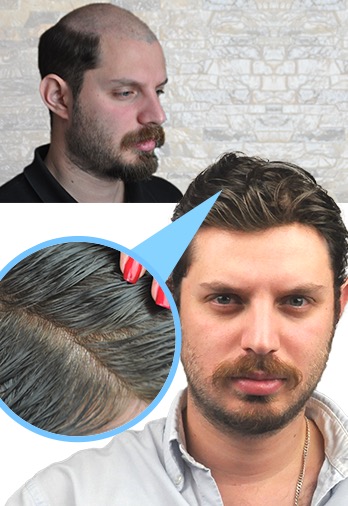


Hair System or Wig?
The two most common solutions people experiencing hair loss come across: hair systems and wigs. They may look similar at first glance, but their technology, the way they are worn, how natural they look and their effect on daily life are completely different. A choice made without knowing those differences can end in disappointment.
A wig is a classic hair replacement method that has been around for centuries, while hair system, developed with modern technology, is prepared specifically for you and, once applied, cannot be told apart from natural hair. Understanding the difference matters not just aesthetically but for comfort, lifespan and everyday wear.
In this guide, the differences between a hair system and a wig are compared in detail in terms of technical features, how they are applied, lifespan, care, price and everyday comfort. You will be able to weigh up clearly which one suits you better.
What Is a Hair System? Modern Technology’s Answer to Hair Loss
A hair system is a bespoke hair solution applied with millimetric precision to the areas where a person is losing hair. It is made from natural human hair or high-quality synthetic fibre, worked onto a thin, breathable base. It is bonded or integrated by a professional and stays in place throughout daily life.
- Design: Prepared to measurements taken specifically for you
- Fitting: Integrated with millimetric precision by professional specialists
- Appearance: Thanks to a natural hairline and strand-by-strand hand-knotting, it cannot be told apart from your existing hair
- Wear: Worn continuously; removal requires a specialist procedure
- Activity: Puts no limits on sport, swimming or showering
Modern hair system applications offer many innovative options, from nano technology to lace front design.
What Is a Wig? The Classic, Familiar Solution
A wig is a hair replacement product designed to cover part or all of the head, made to standard sizes and usually mass-produced. It generally has an elastic base and can be put on and taken off by the wearer independently.
- Design: Standard sizes, mostly mass-produced
- Fitting: Easily put on and taken off by the wearer
- Appearance: Usually noticeable as “worn”; the natural hairline is limited
- Wear: Put on daily and taken off at night
- Activity: Creates limits in sport, swimming and windy weather
A wig can be considered a temporary, quick solution; but in terms of naturalness and everyday comfort it lags far behind hair system technology.
Hair System vs Wig: Comparison Table
A detailed comparison where you can see all the features of both methods side by side:
| Feature | Hair System | Wig |
|---|---|---|
| Design | Bespoke measurements | Standard sizes |
| Application | Professional application, permanent | Put on and taken off by the wearer |
| Natural Look | Indistinguishable from natural hair | Noticeable |
| Comfort | Light, breathable | Can feel tight and hot |
| Activity | Sport, swimming and showering are free | Risk of slipping during activity |
| Lifespan | 12–24 months | 3–12 months |
| Hairline | Lace front, micro-craftsmanship | Limited, standard |
| Care | Regular professional care | Home care |
| Price Range | 10,000–40,000 TL | 2,000–15,000 TL |
| Psychological Effect | Full confidence | Worry about slipping |
The table shows that a hair system is superior to a wig in almost every respect. On cost alone a wig may look more economical, but in terms of the wearing experience and appearance they are in different leagues.
Compared on Naturalness
The biggest expectation when choosing a hair replacement method is a natural look. The human eye can pick up even a minimal flaw in the hairline and texture.
- Hairline: A hair system offers a natural hairline that matches the skin and fades out, thanks to lace front technology. A wig, with its standard front cut, usually looks artificial.
- Hair Direction: In a hair system every strand is directed individually. In wigs the hair is stitched in bundles, so the flow is limited.
- Skin Match: With a nano base and transparent lace, a hair system all but “melts” into the skin. A wig base is clearly noticeable.
- Natural Movement: A hair system moves with the same dynamics as your head; a wig can slip while you move.
For wearers unwilling to compromise on naturalness, a hair system stands out by a wide margin. For all the models see hair system models page.
Compared on Everyday Comfort
The success of a hair replacement product is measured by whether you feel it in daily life. What you go through from the moment you wake up until you go to bed tells you whether you chose right.
- The Morning Routine: With a hair system your hair is ready when you wake up; a quick tidy is enough. A wig has to be put on every morning.
- Comfort at Work: A hair system creates no worry about slipping; it causes no trouble even in windy weather. A wig needs constant checking.
- Sport: Running, yoga, the gym and so on are easy with a hair system. With a wig the risk of slipping is high.
- Social Life: In the rain, at the beach, on the dance floor, a hair system behaves naturally. A wig allows only limited freedom.
- Close Relationships: A hair system is natural enough for a partner to run their hand through it.
Quality of daily life is not just about appearance. Comfort, confidence and freedom are the fundamental advantages of a hair system over a wig.
When Is a Hair System Right, and When Is a Wig?
Both products have their use cases. To make the right choice, read the guide below:
- Choose a Hair System If: you want a long-term solution, a natural look matters to you, you have an active lifestyle, or you are ready to invest in something permanent.
- A Wig May Be Right If: you need it temporarily (for example during chemotherapy), you want to switch between different looks day to day, or your starting budget is low.
If you are looking for a temporary solution for hair loss during chemotherapy, see hair loss during chemotherapy .
Differences in What Men and Women Choose
There are clear differences by gender in choosing between a hair system and a wig. Hair systems for men and hair systems for women applications involve different technical requirements.
- For men: Partial applications such as the crown or front hairline are mostly done with a hair system. A men’s wig is not practical and creates a naturalness problem.
- For women: Because long hair and volume are involved, both wigs and hair systems are considered. But in daily wear a hair system is far more practical.
For both, the right choice should be made after a professional hair analysis.
Differences in Care and Lifespan
Hair systems and wigs also differ clearly in how they are cared for and how long they last. Proper care extends the life of both, but they need different approaches.
- Hair System Care: Care at a professional centre is needed every four to six weeks. Regular care can extend the product’s life to 24 months.
- Wig Care: The wearer washes and styles it themselves. Professional care is rarely needed, but the life is shorter.
- Storage: A wig has to be kept on a special stand at night. A hair system stays on continuously, so no storage is needed.
- Reapply: A hair system is replaced every 12 to 24 months. A wig wears out in three to twelve.
Getting professional care is a critical step in wearing a hair system long-term.
The Psychological Effect: The Confidence Factor
The method you choose has a major psychological effect, not just a visual one. Constantly worrying that “my hair will show or slip” directly affects social life and confidence.
- Hair System: Because it feels natural, wearers eventually forget it is a hair system. It feels like transplanted natural hair.
- Wig: The constant “is it sitting right?” worry drains the wearer’s mental energy. It can create a sense of limitation in social life.
To look at the psychological effects of hair loss in more detail, see the psychological effects of hair loss .
Men’s Wig or Hair System? A Detailed Comparison
For male wearers the choice between a wig and a hair system differs greatly. In male-pattern hair loss the two methods suit the crown and front area very differently:
- The Problems With a Men’s Wig: A visible hairline, a high risk of slipping, and because the hair is short, it is noticeable.
- The Advantages of a Men’s Hair System: A natural hairline, permanent wear, and compatibility with sport and an active life.
- Matching the Beard: With a hair system the hairline can be designed to integrate with the beard.
- Fitting Work Life: A hair system works for meetings, events and social occasions.
For details see hair systems for men page.
Women’s Wig or Hair System? Volume and Style Compared
For female wearers the choice is broader. Volume, length and style preferences are the deciding factors:
- The Advantages of a Women’s Wig: A quick change of style, trying different colours, practical use at events.
- The Advantages of a Women’s Hair System: A continuously natural look, ease in romantic relationships, long-term wear.
- Volume: With a hair system the volume is more natural and more sustainable.
- Changing Your Style: A hair system can be cut and styled too.
For details see hair systems for women our page and women wearing hair systems .
Wig and Hair System Prices 2026: A Detailed Cost Analysis
The price ranges of the two products address different markets:
| Category | Wig | Hair System |
|---|---|---|
| Budget | 1,000–3,000 TL | 10,000–15,000 TL |
| Mid Segment | 3,000–7,000 TL | 15,000–25,000 TL |
| Premium | 7,000–15,000 TL | 25,000–40,000 TL |
| Lifespan | 3–12 months | 12–24 months |
| Average Monthly Cost | 300–1,250 TL | 800–1,700 TL |
The table shows that in the short term a wig is more economical; but once you work out the average monthly cost, a hair system is far more advantageous. For chemotherapy or temporary hair loss a wig may make more sense. For details see hair loss during chemotherapy .
Hair Replacement After Illness: Wig or Hair System?
After medical conditions such as chemotherapy, alopecia areata or radiotherapy, the choice depends on how long the loss lasts and what type it is:
- During Chemotherapy: Because the loss is temporary, a wig may make more sense. Hair loss during chemotherapy
- After Radiotherapy: Assessed according to the potential for regrowth. Hair loss during radiotherapy
- Alopecia Areata: In widespread patchy loss a hair system gives a more natural result. Alopecia areata
- Hormonal Hair Loss: When it is permanent, a hair system is recommended. Hormonal hair loss
- Thyroid-Related: There can be regrowth once the condition is treated. Thyroid-related hair loss
After an illness, medical approval and expert advice are essential for the right choice.
The Social Problems Wigs Create, and the Hair System Answer
Many wig wearers talk about the difficulties they face in social settings. A hair system solves most of them:
- Worry About Wind: A wig can be exposed; a hair system stays put.
- Anxiety in the Rain: A wig getting wet can be a problem; a hair system is fine.
- Hesitancy About Close Contact: In romantic relationships a hair system gives complete freedom.
- Playing With Children: A hair system does not come apart even in close contact with a child.
- The Gym: A wig creates a risk of slipping; a hair system suits sporting activity.
- Social Events: At weddings, birthdays and similar events a hair system gives complete freedom.
In terms of quality of social life, a hair system makes an enormous difference.
When Is a Wig Useful?
A wig is not always the wrong choice. In some situations it is the more sensible option:
- Temporary Hair Loss: Short-term wear during treatment.
- Changing Your Style: For those who want to try different looks.
- Budget Constraints: Situations needing an urgent, economical answer.
- Theatre / Film: For professional use.
- Special Occasions: One-off use at weddings and receptions.
- A Trial Stage: Gaining experience before moving to a hair system.
Every product has its own place and value; the right choice should be made according to need.
NeoHair’s Recommendation for the Right Choice
Make the right investment for your future satisfaction. NeoHair team determines the solution best suited to you with a free hair analysis. You can get professional advice on all your questions about hair systems and wigs.
Frequently Asked Questions
Related Posts

In Which Cases Is a Hair System Applied
Hair loss has been one of men’s main problems from the past to the present. Although it is seen in men, it is seen just as often in…
Read More
The Stages of Making a Hair System
Hair transplant Hair systems, chosen more often than that method and used more and more, bring the question “What is this hair system method?” to mind. First of…
Read More
How Long Does a Nanotechnology Hair System Last?
The service life of nanotechnology hair systems varies according to the material used in making them, correct wear and the care carried out. The technology used in making…
Read More