

Is a Hair System Permissible in Islam?
The appearance of your hair is one of the elements that most deeply affects self-confidence, outward appearance and how you express yourself in social life. While many people experiencing hair loss research different methods to regain a natural look, hair systemhas become one of the leading solutions because it requires no surgery, delivers fast results and fits into everyday life. But one of the most frequently asked questions about this method is this: Is a hair system permissible from a religious point of view?
This question is especially valuable for people who want to change their appearance but also care about preserving their religious sensitivities. Because when every step you take is right both aesthetically and religiously, it directly affects your inner peace. That is precisely why it is so important to offer accurate and trustworthy information about the structure of a hair system, how it is applied and its place in Islam.
In this article we will explain in the simplest terms what a hair system is, and also address the most frequently asked questions such as What is the Islamic ruling on a hair system? Is it permissible? What is its effect on ablution and prayer? clearly, understandably and in line with expert opinion. The aim is to make sure that while you make an aesthetic choice, your heart and mind are completely at ease.
Is a Hair System Permissible? A Religious Perspective
A hair system is a modern hair restoration method, requiring no surgical intervention, that people experiencing hair loss choose to regain their natural appearance. Because it is worn with adhesive and is fully removable, it raises the question “Is a hair system permissible?” among people with religious sensitivities in particular.
According to the majority of Islamic scholars a hair system is permissible; because the real hair follicles are not interfered with, the procedure is not permanent, and it can be put on and taken off in line with need and aesthetics. In these respects it is assessed differently from the logic of hair extension (a wig), which is considered contrary to religious rulings.
Because a hair system can be put on and taken off afterwards, does no harm to the person’s own hair follicles, and is used in line with medical/aesthetic needs, it is assessed within the limits of permission set by scholars of fiqh. The reasoning the Presidency of Religious Affairs applies in similar matters also supports this view.
- It is not a permanent operation: It can be put on and taken off.
- The hair follicles are not interfered with: No medical operation is performed.
- Its purpose is to improve appearance: It is not used for the purpose of deception.
- It falls within the scope of need: Baldness can create psychological and social difficulty.
- Ablution & prayer: Because a hair system is removable, it is no obstacle to ghusl or ablution.
In conclusion, for people who want to make a choice with an easy conscience about whether wearing a hair system is religiously appropriate, expert opinion draws a clear framework. Applied correctly, it provides both a natural appearance and the opportunity to preserve religious sensitivities.
What Is a Hair System?
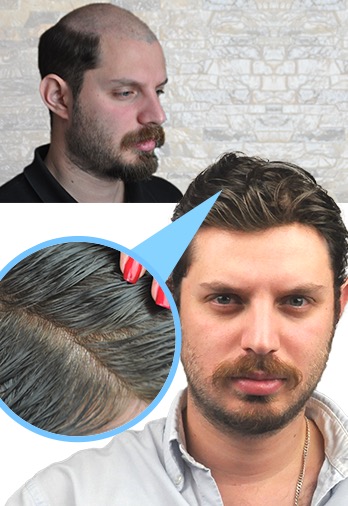
Hair Systemis a modern hair restoration method that gives people experiencing hair loss a natural head of hair again without any surgery. It is created by working real human hair onto a thin, breathable base prepared specifically for you. Thanks to its removable structure it offers practical use and does no harm whatsoever to your hair follicles.
A hair system is a hair restoration method that requires no surgery, does no harm to the hair follicles, is fully removable and is custom-made for you. Unlike synthetic hair, natural human hair is used to achieve the look of real hair.
This definition is critically important for understanding the technical side of the method correctly, both aesthetically and before any religious assessment is made. Because a hair system is not a permanent medical intervention and does not touch the hair follicles, many people choose it with confidence.
- It is a non-surgical solution: No cutting, suturing or transplant procedure is applied.
- It can be put on and taken off: It has a structure that can be removed completely whenever you wish.
- It does not damage the hair follicles: It does not fuse directly with the skin, and the follicles are not interfered with.
- It is not a transplant procedure: No follicle transfer is carried out and there are no surgical processes.
- Natural human hair is used: Unlike synthetic hair, it provides a completely natural appearance.
A hair system is one of the most modern and reliable methods for people who want no surgery, seek fast results and want a natural head of hair in everyday life. NeoHair’s custom production and expert application experience make this method flawless.
A Hair System During Ablution and Prayer
In acts of worship such as prayer and ablution, it matters that water makes free contact with the body and that the intention is correct. People who wear a hair system often face questions such as “Should I take my hair system off when performing ablution?” or “If the adhesive is waterproof, is that a problem during prayer?” Below you will find an explanation of these questions that observes the principles of fiqh and offers practical recommendations.
Ablution: In most cases ablution can be performed without removing the hair system (by wiping the head or checking over it).
Ghusl (full-body washing): If the hair system prevents water from reaching the scalp, removing it is advised; otherwise the conditions of ghusl may not be fulfilled. For a definitive ruling, the person’s school of law and local religious guidance should be taken into account.
More detailed explanations, practical recommendations and the steps to take in various situations are set out below.
- Is a hair system removed when performing ablution?
– If the hair system does not cover the whole head and water can easily reach the scalp, ablution can be performed normally, or the masah (wiping of the head) accepted by your school of law can be applied.
– If the base of the hair system blocks water and this restricts water from reaching the scalp, some religious authorities recommend removing the system before ablution. For this reason the water permeability of the base should be known before application. - An assessment based on the water permeability of the adhesive
– Most current hair system adhesives are skin-friendly, water-resistant formulas. However, if one forms a “waterproof” barrier it can prevent water from penetrating to the skin.
– Practical advice: testing the head area with water while the system is worn, or asking the application centre (e.g. NeoHair) about the water permeability of the adhesive, is the right step. If water does not pass through, removing the system is considered religiously safer in situations requiring ghusl or full wetting. - The position with regard to ghusl (full washing)
– The purpose of ghusl is for the whole body to make contact with water. If the base of the system prevents water from reaching the scalp, the condition of ghusl is not fully met; for this reason it is advised that the hair system be removed in circumstances requiring ghusl.
– If ghusl is to be performed without removing the system, you must be sure that water reaches the scalp directly. If there is any doubt on this point, the system should be taken off.
In practice, the following easy and safe steps are recommended for hair system wearers:
- Get information before application: Ask the centre applying the system (such as NeoHair) for clear information about the type of adhesive and its water permeability.
- Do a short test: At home, use a small water test to check whether water passes through the base of the system.
- If you have doubts during ablution: Depending on the practices of your school of law, masah or temporarily removing the system may be preferred.
- When ghusl is required: To be safe, removing the system is the most correct approach.
- Consult in cases of religious doubt: For a definitive ruling, consult the religious authority in your area; practices may differ between schools of law.
Finally, it should not be forgotten that what is truly decisive in matters of worship is intention and responsible conduct. If a hair system carries no intent to deceive and is applied in a way that does not obstruct religious requirements, according to most approaches in fiqh it presents no objection.
NeoHair’s Ethical Approach
At NeoHair, in every hair system application we make it our principle not only to deliver an aesthetic change but also to remain committed to ethical values and professional responsibility . For us, a hair system is not about “trying to make someone look like a different person”; it is a support method that helps a person feel better, more confident and more natural. That is why transparency, honesty, informing our clients and trust are our fundamental principles in every application.
- Naturalness Is Our Core Principle: Every hair system applied at NeoHair is planned to suit the person’s facial features, skin tone, hair density and age. The aim is therefore not to “create a new person” but to strengthen the person’s own natural appearance.
- Application Guided by Ethical Principles: Because the religious status of hair systems is often debated, NeoHair never supports procedures intended to deceive. All of our clients know exactly what they are doing, the system is in a removable form, and the person’s original hair follicles and health are never interfered with in any way.
- Information and Consent Process: Before application, every person is given a detailed explanation of how the system works, its advantages, its maintenance requirements, the religious questions people wonder about and the ethical framework. Every procedure is carried out with the user’s fully informed consent.
- There Is No Intent to Deceive: In NeoHair’s approach, a hair system is not intended to hide a flaw or mislead others. Just like glasses, dental fillings, orthopaedic supports or medical aesthetic procedures, it is a professional solution intended to increase a person’s comfort in life and level of self-confidence.
- Respect for Hair Health: All the systems we use consist of dermatologically safe materials with an air- and water-permeable base structure that does not damage the scalp. A hair system therefore involves no permanent interventions such as transplants, surgery or invasive procedures.
NeoHair’s ethical stance rests not only on technical excellence but also on respect for the person’s privacy, faith, health and happiness . We personalise the application for every client, guide them according to their needs, and never put commercial concerns first.
Related Posts
The Stages of Making a Hair System
Hair transplant Hair systems, chosen more often than that method and used more and more, bring the question “What is this hair system method?” to mind. First of…
Read More
In Which Cases Is a Hair System Applied
Hair loss has been one of men’s main problems from the past to the present. Although it is seen in men, it is seen just as often in…
Read More
How Long Does a Nanotechnology Hair System Last?
The service life of nanotechnology hair systems varies according to the material used in making them, correct wear and the care carried out. The technology used in making…
Read More